Blog Series
From Shannon to Transformers: The Foundations of Modern AI
Before transformers, there was a long journey of ideas that shaped how machines learn, process information, and understand language. This series explores the foundational papers and breakthroughs behind modern AI, from Claude Shannon's experiments with English letters, bigrams, and information theory to statistical language models, neural networks, and the ideas that eventually led to transformers. We'll work through the original papers step by step, unpack the mathematics intuitively, and reconstruct the key ideas through examples and experiments. The goal isn't just to understand what these papers say, but to discover why these ideas mattered and how they connect to the AI systems we build today.
Series progress
0 of 2 parts completed
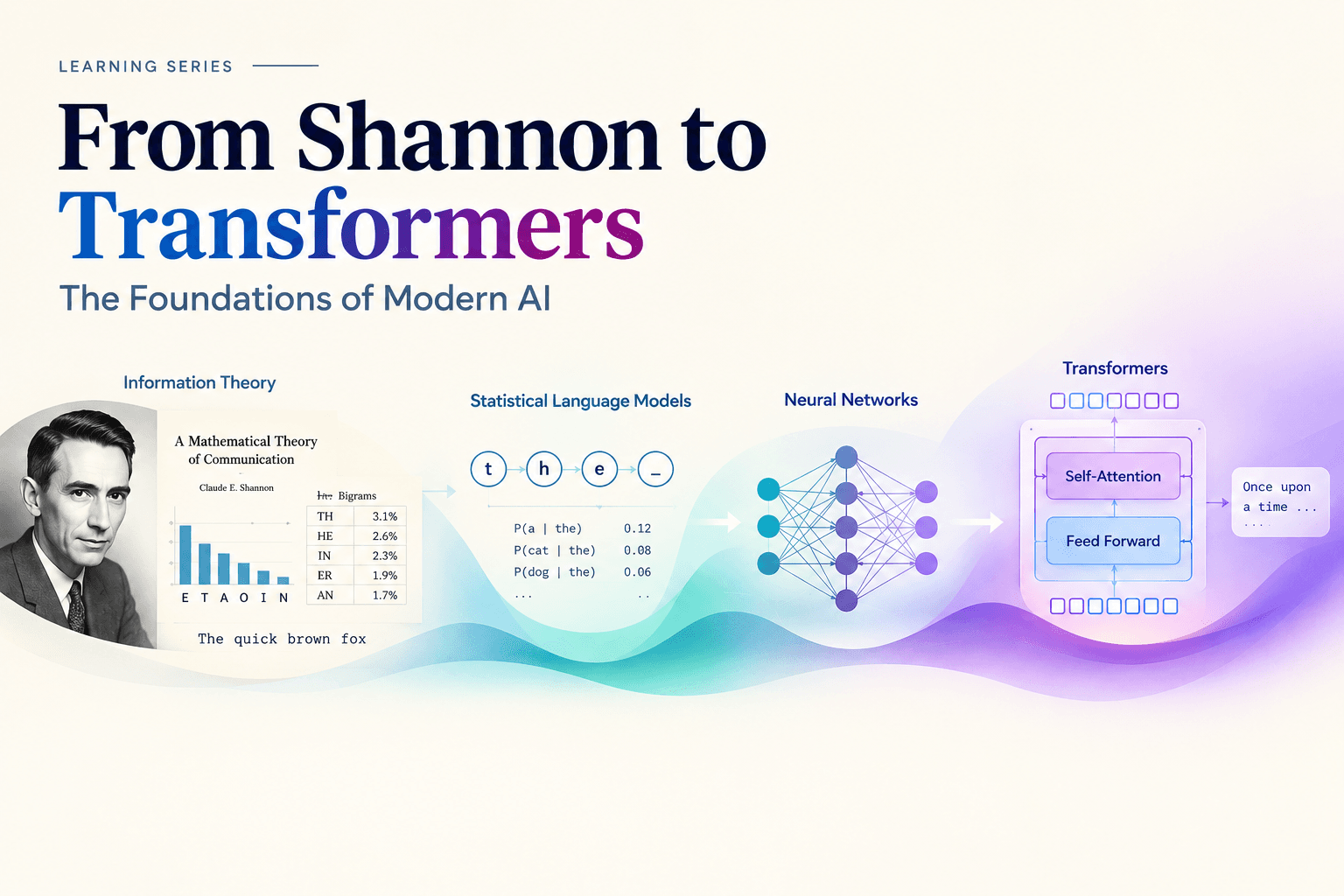
Part 1: Shannon (1948) — Entropy, N-grams, and Guessing the Next Letter
Part 1 of From Shannon to Transformers. We open Shannon's 1948 paper, rebuild his famous approximations to English in 60 lines of Python, and build entropy from yes/no questions up to the formula behind today's LLM loss.
Part 2: Shannon (1951) — The Guessing Game That Put English Near One Bit per Letter
Part 2 of From Shannon to Transformers. Shannon turned people into language models, made them guess text one letter at a time, and squeezed English down to about one bit per letter. We rebuild his guessing game in Python and let an n-gram model play against him.